
System Sizing
We recommend placing AxON systems in locations with direct sunlight and minimal shading. If the panel receives shading from trees or buildings, it likely won’t perform well.
The key to sizing the system is understanding the power consumption of your device and the available solar energy at your location. The CORE System Sizing page has more detailed sizing logic; this page is a simplified version.
Step 1: Determine Your Power Consumption in Watt Hours
Section titled “Step 1: Determine Your Power Consumption in Watt Hours”If possible, don’t rely only on the manufacturer’s datasheet, as its figures are often on the high side. We suggest measuring the power consumption with a USB multimeter, available on Amazon. If your device uses 1.2Wh while running for 3 hours, its power consumption is about 9.6Wh per day.
The popular PUC by BirdWeather consumes 7 to 8Wh per day.
Step 2: Choose a System Based on Daily Power Consumption and Location
Section titled “Step 2: Choose a System Based on Daily Power Consumption and Location”This map from the National Renewable Energy Laboratory (NREL) shows average daily solar radiation in December, and covers only the US. If you’re outside the US, you can cross-reference global insolation maps (opens in a new tab).
Select a system that produces more energy in December than your device consumes. We recommend oversizing where possible.
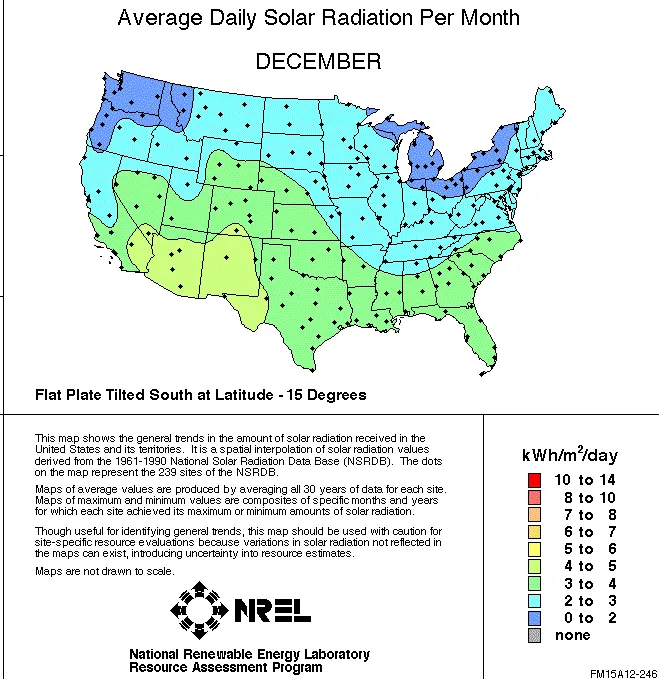
Expected Energy Available in December
Section titled “Expected Energy Available in December”Watt hours per day, by region on the map.
| Region (map color) | 5W AxON (opens in a new tab) | 10W AxON (opens in a new tab) | 20W AxON (opens in a new tab) |
|---|---|---|---|
| Light green (desert Southwest) | 12 | 24 | 36 |
| Green (South and lower Midwest) | 9 | 18 | 27 |
| Light blue (Northeast and Upper Midwest) | 6 | 12 | 18 |
| Dark blue (Pacific Northwest and Great Lakes region) | 3.5 | 7 | 12 |
A few notes:
- These figures include losses from the charge circuit, the transformation of electrical energy (solar panel) to chemical energy (battery), and output regulation.
- The 20W system doesn’t produce double the energy of the 10W system, because the battery input is capped at 10W.
- No one gets upset about having too much solar power. Size up if possible.
Step 3: Understand Temperature Limitations
Section titled “Step 3: Understand Temperature Limitations”AxON batteries don’t charge below freezing (0°C). If there are multiple days below freezing, the system is likely to lose power. It recovers when the temperature goes above freezing. For critical systems, consider the larger CORE line of products.
Step 4: Check Shading on ShadeMap
Section titled “Step 4: Check Shading on ShadeMap”Solar panel performance drops if the panel isn’t facing south or is shaded. Before deploying, check your location on ShadeMap (opens in a new tab) in June and December.